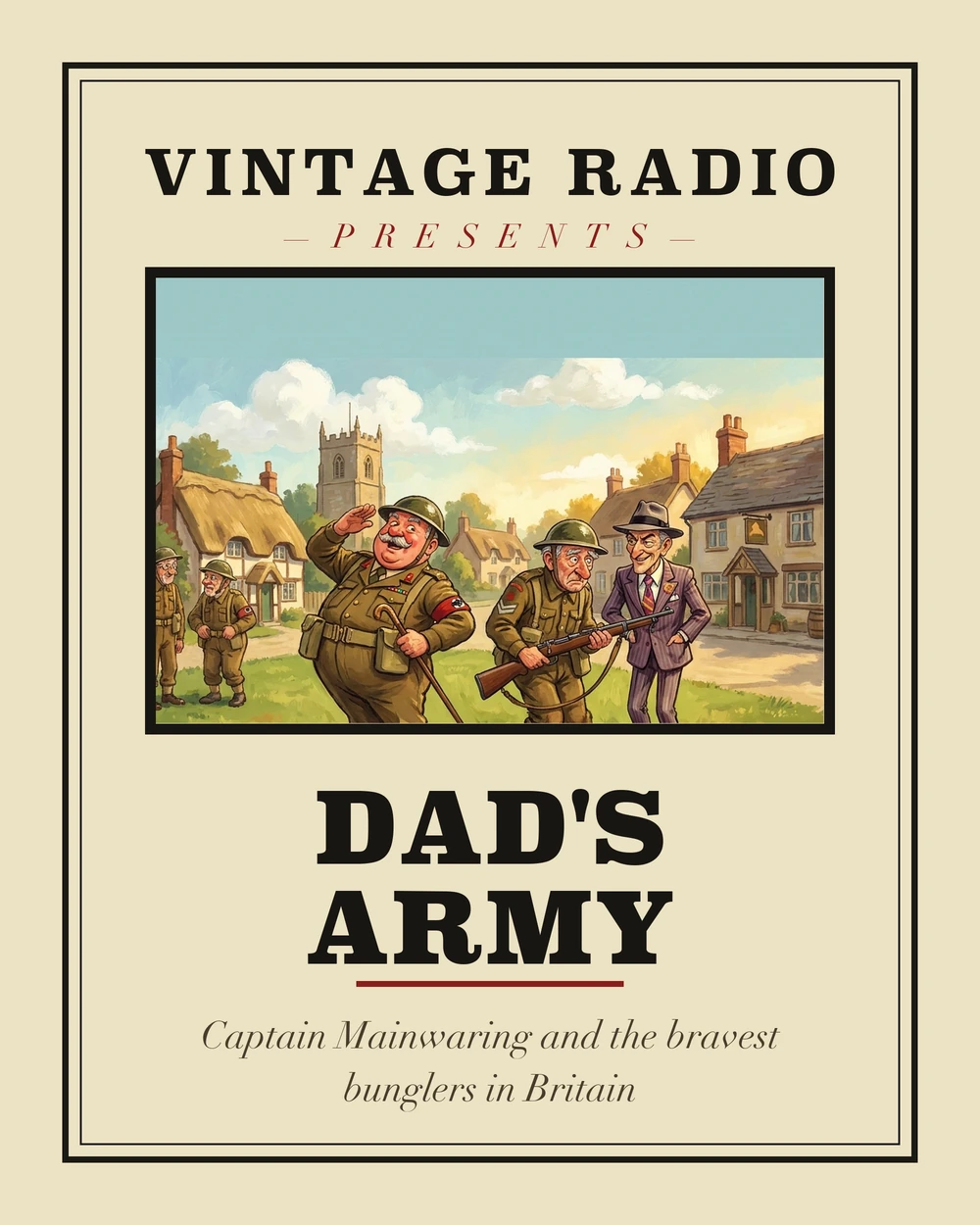
Dad's Army
How It Got on the Air
Dad's Army began with a personal memory. Jimmy Perry had joined the Local Defence Volunteers — later reorganized as the Home Guard — at age sixteen, enlisting in the 10th Hertfordshire Battalion. He spent years turning that experience into a script, writing it while working as a minor actor on David Croft's sitcom Hugh and I. Croft read it, saw the potential, and passed it to BBC Head of Comedy Michael Mills. Mills commissioned the series, but not before making two changes: he renamed Perry's original title The Fighting Tigers, calling it Dad's Army instead, and shifted the fictional setting from Brightsea-on-Sea to Walmington-on-Sea. The show premiered on BBC1 on 31 July 1968.
Perry and Croft shared the writing duties across the full run. Their partnership earned them Writers' Guild of Great Britain awards in 1969, 1970, and 1971, and both men were awarded the OBE in 1978 for services to television. The comedy they built together ran for nine series and 80 episodes — the first two in black-and-white and the remaining seven in colour — finishing on 13 November 1977.
The World It Was Set In
The premise placed a platoon of Home Guard volunteers in Walmington-on-Sea, a fictional town on the south coast of England depicted as sitting not far from Eastbourne — which meant, in wartime terms, the platoon would have been on the front line if Germany had ever crossed the Channel. That geographic detail gave the show a quiet edge beneath the comedy. These men were genuinely defending something, even if their efforts rarely went to plan.
The Home Guard drew its membership from men ineligible for regular military service: too old, too young, in reserved occupations. Walmington-on-Sea's platoon reflected all of that. Captain Mainwaring, played by Arthur Lowe, ran the local branch of Swallow Bank and brought the same stiff managerial authority to his military rank — with similar results. Sergeant Wilson, played by John Le Mesurier, served as the bank's chief clerk in civilian life and Mainwaring's second-in-command in uniform, his languid understatement a constant counterweight to Mainwaring's bluster. Private Pike, played by Ian Lavender and partly modelled by Perry on his younger self, completed the core trio: well-meaning, not especially sharp, and the object of more than a little exasperation from his commanding officer.
The Cast That Made It Work
The wider ensemble was built just as carefully. Clive Dunn played Lance Corporal Jones, the local butcher, whose rambling war stories and catchphrase urgency became signatures of the show. John Laurie's Private Frazer was a dour Scottish undertaker whose habit of announcing that the platoon was doomed played against Jones's cheerful panic to considerable effect. Arnold Ridley's Private Godfrey brought a gentle, slightly frail dignity to proceedings. James Beck's Private Walker — a Cockney spiv with a sideline in acquiring things that were technically unavailable — rounded out the main group.
Beck's death during production of the sixth series in 1973 was a significant loss. He was forty-four and died suddenly from pancreatitis. Walker was written out without being replaced, and the show continued with the gap quietly acknowledged. The cast had been unusually stable before that, and the chemistry between the principal players was a large part of what made the comedy work. Ian Lavender's death in 2024 left no surviving principal cast members from the original television run.
The Sound of the Show
One detail Perry got exactly right was the theme tune. "Who Do You Think You Are Kidding, Mr. Hitler?" was written by Perry and Derek Taverner and performed by Bud Flanagan, a wartime entertainer and one of Perry's childhood idols. Perry paid Flanagan 100 guineas for the recording, and Flanagan died less than a year after making it. The song worked because it genuinely sounded like a period piece — not a pastiche of wartime music but something that could plausibly have come from the era it was depicting. Perry won the Ivor Novello Award for it in 1971.
Exterior filming was done in and around the Stanford Training Area near Thetford in Norfolk, a landscape that stood in effectively for the English south coast. Interior studio scenes were recorded at BBC Television Centre in West London. Thetford itself became closely associated with the show — the old fire station at the rear of the Guildhall, which appears in several episodes as Walmington-on-Sea Town Hall, now houses a museum dedicated to the series, and a bronze statue of Captain Mainwaring was erected in the town in June 2010.
Why It Ran So Long
At its peak the show drew audiences of around 18 million viewers. That number reflects something beyond the comedy itself. The show balanced the humour of incompetence with a genuine warmth for the people it was depicting. Mainwaring was pompous and frequently wrong, but he was also sincere. The platoon was hapless, but they showed up. The comedy never mocked the underlying impulse — the idea of ordinary people standing in for something larger — and that restraint gave the show an emotional register that outlasted the laugh lines.
The show won the BAFTA Award for Best Comedy in 1971. Decades later, in the 2004 BBC poll to find Britain's Best Sitcom, it came fourth, and the British Film Institute's 2000 list of the 100 Greatest British Television Programmes ranked it thirteenth. Those rankings reflect a show that was taken seriously as a piece of television-making, not just remembered fondly.
Beyond the Television Series
The show extended into other forms without losing much in translation. A BBC Radio 4 adaptation ran across three series from 28 January 1974 to 7 July 1976, totalling 67 episodes. It used the original television cast and scripts adapted by Harold Snoad and Michael Knowles — a rare arrangement that gave the radio version genuine continuity with what audiences already knew.
A feature film was released in 1971, produced in association with Columbia Pictures. A stage show, Dad's Army: A Nostalgic Music and Laughter Show of Britain's Finest Hour, opened at the Shaftesbury Theatre in London's West End on 2 October 1975, ran until February 1976, and then toured. An American remake pilot, The Rear Guard, was produced by ABC and broadcast on 10 August 1976, adapted from the episode "The Deadly Attachment." It received poor feedback and was not developed into a series. A second feature film with a different cast followed in 2016, and the series continues to be broadcast internationally. The catalog available here covers 66 of the show's 80 television episodes across the nine-series run.